
Area Resources
How to get a Certificate of Appropriateness in German Village
By Matt Cochrell · Broker/Owner, MDC Realty Limited
Last updated
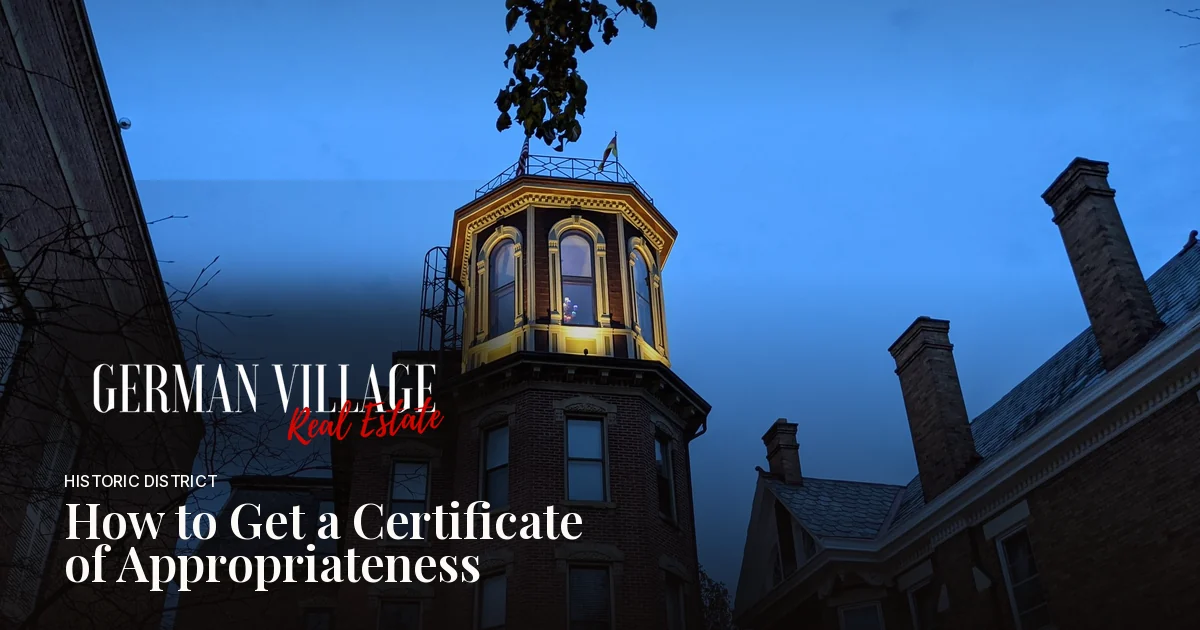
If you plan exterior work on a house in the German Village Historic District, you will usually need a Certificate of Appropriateness (COA) from the German Village Commission before that work starts. This walkthrough covers how to file in the city’s Citizens Access Portal, when staff can approve routine items without a hearing, and how to use the official meeting calendar. It is a companion to our historic district rules and renovation guide, and is not legal advice.
Buyers who want to change a house after closing should understand this process before they bid. Start with MDC at mdclimited.com/buy. If you already own the house and are doing exterior work before a listing, the same COA rules apply; MDC can also talk through a sale at mdclimited.com/sell.
What a Certificate of Appropriateness is
The German Village Commission “considers applications and issues Certificates of Appropriateness for exterior alterations at properties located within the German Village Historic District boundaries, pursuant to Columbus City Code chapters 3116 and 3119 and the German Village District Guidelines.” The official city page says the Commission and the Historic District were established by Ordinance Nos. 976-60 and 1221-60 in 1960, and the Commission Guidelines were adopted in 1989. (City of Columbus – German Village Commission)
A COA is not itself a building, sign, or demolition permit. After staff or the Commission issues a written COA, take the stamped drawings and the COA to Building & Zoning Services for any required permits. (Information for Applicants) Confirm the address first on the city’s historic and design-review map. The German Village Society is useful secondary context; for legal requirements and deadlines, use the city.
Current Columbus City Code Chapters 3116, 3118, and 3119 could not be opened on November 25, 2026. Code quotations on this page are from a 2022 federal court opinion, Stevens v. City of Columbus, labeled as 2022 text, not confirmed current code. (Stevens, No. 21-3755 (6th Cir. 2022))
What work typically needs a COA
The official Commission page describes review of exterior alterations in the district. The city’s Historic Preservation hub says a COA may also be required for a change of use, rezoning or a variance, signs and graphics, landscaping, demolition, new construction, and lot combinations. The undated Historic Common Staff Approval List covers routine items such as paint, windows, roofing, fences, and doors, so those work types are in the COA system even when they can skip a hearing.
A 2022 court quotation of then-effective § 3116.04 required a COA before a person could “construct, reconstruct, alter, change the exterior color of or demolish any listed property or architectural feature . . . or make site improvements” in a historic district, except for public-safety cases. Official city pages describe the GVC COA as being for exterior work and related site or zoning items. This page does not state a hard rule that interior work never needs a COA, because the current exclusions section was not readable.
| Work type | Typically needs a COA? | Staff-approvable if it matches the official list exactly? | Otherwise |
|---|---|---|---|
| Exterior alterations | Yes, per the GVC page | Only if the item is on the staff list and consistent with the code and guidelines | Full Commission hearing |
| Paint / exterior color | Yes | Painting with manufacturer’s chips and current photos, if it meets the list | Full Commission, including painting unpainted masonry |
| Windows | Yes | Historic-window repair; certain storm windows; some replacements from the Approved Windows List after staff assessment | Full Commission otherwise |
| Roofing | Yes | Some like-kind asphalt, rubber, metal, or matching-slate items on the staff list | Full Commission otherwise; see the slate note |
| Fences | Yes | A 6-foot wood board-on-board rear-yard privacy fence with a site plan, if it meets the list (see GVC fence notes below) | Other styles, heights, or locations, including typical front-yard fences |
| Signs / graphics | Yes | Some in-kind refacing and hanging signs (GVC hanging-sign cap: 6 sq. ft.) | Full Commission for other signs |
| Demolition | Yes | Not a staff-approval category | Full Commission |
| New construction / additions | Yes | Only a narrow rear-yard shed item (no foundation; not over 168 sq. ft. or 8 ft. high; no plastic, vinyl, or faux wood-grain siding) | Full Commission for houses, additions, and most outbuildings |
| Siding | Yes | Removal of non-original siding and repair of historic siding | Full Commission for new or replacement siding. The modern-siding staff item does not apply to GVC. |
The table is not a substitute for staff review. The Approved Windows List and Approved Shingles List are referenced by the staff list, but standalone current official files were not found on November 25, 2026. Ask GVC staff for the current lists.
Slate roofs need a careful read. The 2005 guidelines amendments (Ordinance 2221-2004) say any proposed repairs or alterations to existing slate roofs require commission review and approval before removal and/or replacement, and that a proposal to remove a slate roof requires a written assessment by a City-licensed slate roofing contractor. The undated staff list still lists “Repair/ replacement of a slate roof with matching slate” as staff-approvable. This page does not pick a winner. Ask GVC staff how to file slate work. (Guidelines Amendments, 2005; Staff Approval List)
Staff approval versus a full Commission hearing
A staff-list item still needs a filed COA application. The staff list says listed items “are reviewed in accordance with CC 3116, and the applicable guidelines,” that the process “includes completing and filing a COA application; however, does not require a hearing,” and that qualifying applications “can generally be staff approved per CC 3119.49.” Staff, not the applicant, decide whether a project qualifies.
If you are seeking staff approval, mark the application as Request for Action, not Conceptual. Conceptual review means the Commission offers feedback and will not take a vote. A request for action is what you mark when you want a vote, or a staff decision. (Accela Citizens Access Portal Guide)
If the work needs a hearing, a representative — the applicant, owner, or a designee — must attend in person. Official minutes say an absence is likely to continue the application. Staff-approved items are typically entered into the formal record later as “Approval of Staff Approvals”; you do not need to treat that consent item as your project hearing. The city’s applicant information says hearing materials are typically sent about a week in advance, which is not a guaranteed timeline.
German Village-specific notes on the staff list (do not generalize them to other districts): hanging signs are capped at 6 square feet, not the 12-square-foot citywide maximum on the same line; dog-eared fencing is not an approved style, and 6-foot height is measured from the grade of the public right-of-way; radon mitigation shall not front on an elevation abutting the public right-of-way; and the modern-siding staff item “Does not apply to GVC.”
How to file in the Citizens Access Portal
The current official method is the city’s Citizens Access Portal. The live Commission page says you can submit related files and a brief description of the work there. For help, email GVC@columbus.gov. If you cannot use the portal, the official 2026 and 2027 schedules say to call 614-724-4437 for alternative delivery. (GVC page; 2027 Meeting Schedule)
Steps, from the city’s Accela portal guide:
- Confirm the address is in the district on the city map. Read the German Village District Guidelines and the 2005 amendments, and compare the work to the staff approval list.
- Register or log in, then start a new application under the Planning tab. Choose the German Village Commission, search the property, and confirm the applicant contact.
- Mark the application Conceptual or Request for Action. For a staff approval or a Commission vote, mark Request for Action.
- Classify the project and write a general description plus a detailed description of the work, including materials.
- Upload attachments, each with a type (examples include elevations, a site plan, and renderings) and a description. Typical files include current photos, material specifications or paint chips, and drawings or plans. Fence and some landscaping items often need a site plan. A proposal to remove a slate roof, under the 2005 amendments, requires a written assessment by a City-licensed slate roofing contractor.
- Sign, review, and submit. Save the record number. Under Record Info you can watch status and, when an approval email says the COA has been uploaded, download the attachment typed “COA.”
- Submit before 4:00 p.m. on the official deadline for the hearing you want, or ask staff whether the work may be staff-approved. If the item is set for hearing, plan for in-person attendance. After a COA is issued, take it and any stamped drawings to Building & Zoning Services for required permits.
The German Village Society tells applicants to submit “no less than one month prior to the hearing.” That is a Society paraphrase; use the official 4:00 p.m. calendar deadlines. (Society Historic Preservation FAQs) An older city PDF still describes emailing a blank COA form. File in the portal unless GVC staff tell you otherwise.
Meetings, deadlines, and the official calendar
Hearings are generally held the first Wednesday of the month at 4:00 p.m. at 111 N. Front St., 2nd Floor, Room 204, and may be live-streamed on the City of Columbus YouTube channel. Business meetings are generally two weeks earlier at 12:00 p.m. in Room 205. Dates and locations can change; confirm with the Historic Preservation Office. Do not treat “first Wednesday” as a hard rule: the official 2027 calendar lists the November 4, 2027, hearing as a Thursday. (GVC page; GVC 2027 Meeting Schedule)
Application deadlines are 4:00 p.m. on the date shown. The schedules also describe a one-week grace period, in some months, for revisions to an application already heard the previous month, but not in months when the deadline already falls at least a week after the hearing.
As of November 25, 2026, the December 2, 2026, hearing is still listed, but its November 5, 2026, application deadline has passed. The next listed hearing is January 6, 2027, with a December 10, 2026, 4:00 p.m. deadline and a December 16, 2026, business meeting (a holiday date change on the official PDFs). Later 2027 dates, including that Thursday hearing, are on the published 2027 calendar (PDF) and the live Commission page.
To speak at a hearing, submit a speaker slip and attend in person. Written comments may be provided by 4:00 p.m. Eastern the day before. Comments on YouTube are not part of the official public record, and business meetings are not streamed. (General Meeting Information) No official post-hearing decision timeline was found.
After a decision: permits and appeals
If a Certificate of Appropriateness is denied, appeals go to the Board of Commission Appeals, under Columbus City Code Chapter 3118. The official appeals page does not publish a filing deadline, a required form, or a fee, so do not assume a 30-day or other deadline. Confirm the current process with the Historic Preservation Office. The page lists Historic Preservation Officer James A. Goodman at jagoodman@columbus.gov. That board meets as needed at 111 N. Front St., Room 204, at 1:00 p.m., and dates may change.
No Certificate of Appropriateness fee was found in the city’s 2026 Combined Development Related Fee Schedule or on the official Commission page. Confirm with the Historic Preservation Office at GVC@columbus.gov or 614-724-4437; this page does not invent a fee. Building, sign, or demolition permit fees are separate.
Contacts
- German Village Commission: GVC@columbus.gov
- Alternative filing or meeting accommodations: 614-724-4437
- Official calendars, agendas, and minutes: the German Village Commission page
- District lookup: the city historic / design-review map
Frequently asked questions
Do I need a Certificate of Appropriateness to change a German Village house?
Generally, yes, if the work is an exterior alteration in the German Village Historic District. The German Village Commission issues Certificates of Appropriateness under Columbus City Code Chapters 3116 and 3119 and the District Guidelines. The city’s Historic Preservation hub also lists demolition, new construction, signs, landscaping, a change of use, rezoning or a variance, and lot combinations as work that may need review. File through the Citizens Access Portal. Some routine items can be staff-approved, but an application is still required. Confirm the address on the city’s map, and ask GVC staff if you are unsure.
How do I apply for a German Village Certificate of Appropriateness?
File in the city’s Citizens Access Portal. Register or log in, start an application under the Planning tab, select the German Village Commission, enter the address, and describe the work. Mark Request for Action if you want a vote or a staff approval; mark Conceptual only if you want feedback without a vote. Upload photos, drawings or plans, and material specifications. Deadlines are 4:00 p.m. on the official calendar. If you cannot use the portal, call 614-724-4437. Questions: GVC@columbus.gov.
Can staff approve my project without a hearing?
Sometimes. The city’s Historic Common Staff Approval List says qualifying applications can generally be staff-approved under CC 3119.49 and do not require a hearing, but a COA application still has to be filed. Staff, not the applicant, decide whether a project matches the list and the guidelines. If you are seeking staff approval, mark the application as Request for Action. German Village notes on that list include a 6-square-foot hanging-sign cap, no dog-eared fencing, and a modern-siding staff item that does not apply here. Ask staff about slate roof work; the 2005 guidelines amendments and the staff list describe it differently.
When does the German Village Commission meet?
Hearings are generally the first Wednesday of the month at 4:00 p.m. at 111 N. Front St., Room 204, but dates can change. The official 2027 calendar lists November 4, 2027, as a Thursday. Application deadlines are 4:00 p.m. As of November 25, 2026, the next listed hearing is January 6, 2027, with a December 10, 2026, 4:00 p.m. deadline. Confirm dates on the official German Village Commission page and the published 2027 calendar.
How do I appeal if a Certificate of Appropriateness is denied?
Appeals of a denial go to the Board of Commission Appeals, under Columbus City Code Chapter 3118. The official appeals page does not publish a filing deadline or a fee, so confirm the current process with the Historic Preservation Office. The page lists Historic Preservation Officer James A. Goodman at jagoodman@columbus.gov. That board meets as needed at 111 N. Front St., Room 204, at 1:00 p.m., and dates may change.
Call to action
If you are buying in German Village and plan to change the house, get this process on your timeline before you bid. Tour and talk it through with MDC at mdclimited.com/buy, or call (614) 383-9885. For the rules behind the application and for renovation planning, use our historic district rules and renovation guide. Confirm filing dates and staff questions with the city at GVC@columbus.gov or 614-724-4437.
Keep reading

German Village vs. Short North
Two Columbus neighborhoods compared: architecture, price, daily life, and ownership.

German Village vs. Italian Village
Two historic districts, two very different versions of urban Columbus living.
Renting in German Village
What's available, what it costs, and how to find a rental in the district.